
When people hear “Pilates,” they usually picture the exercises. The Hundred. The Teaser. The reformer. All the iconic stuff.
But here’s the thing: sometimes, we are not ready to jump straight into those movements.
That’s where Pre-Pilates comes in.
I like to think of Pre-Pilates as the quiet beginning of Pilates. It’s the part where you learn how to move before you worry about what the movement is called. It’s breathing, finding your ribs, noticing your pelvis, waking up muscles that have been offline for years. It can look simple — sometimes almost too simple — but it’s doing the deep work that makes the full exercises possible later.
Joseph Pilates constantly adapted exercises and apparatus for the person in front of him. That spirit of individualization was carried forward by teachers like Eve Gentry and Kathy Grant, whose influence has been profound. In many ways, how so many of us teach today simply wouldn’t exist without them.
Eve Gentry’s story is incredibly human and honestly pretty emotional. In the 1950s she had a radical mastectomy after breast cancer. Instead of stepping away from movement, she used Pilates to rebuild herself*. She would teach in a slower, gentler and more curious way. She focused on breathing, rib movement, and small foundational patterns. She helped people who were injured, in pain, or recovering from surgery. A lot of what we now think of as foundational Pilates traces back to her teaching.
Kathy Grant took things in another direction, but with the same spirit of accessibility. She taught at NYU for decades. She was incredibly creative. She used towels, balls, cushions — anything that could help someone understand a movement. Her big belief was that you don’t teach exercises — you teach bodies. Instead of pushing people toward the “final version” of an exercise, she created stepping stones. Little progressions that built strength, awareness, and confidence over time. That progression mindset is basically the backbone of how we teach beginners today.
So when we talk about Pre-Pilates now, we’re really talking about the evolution of the method.
Joseph Pilates created the system.
Eve Gentry helped make it healing.
Kathy Grant helped make it accessible.
Pre-Pilates is the bridge they built so that more people could actually arrive at the work. Once we understand these small, simple movements, they start feeling like the an essential part of the practice.
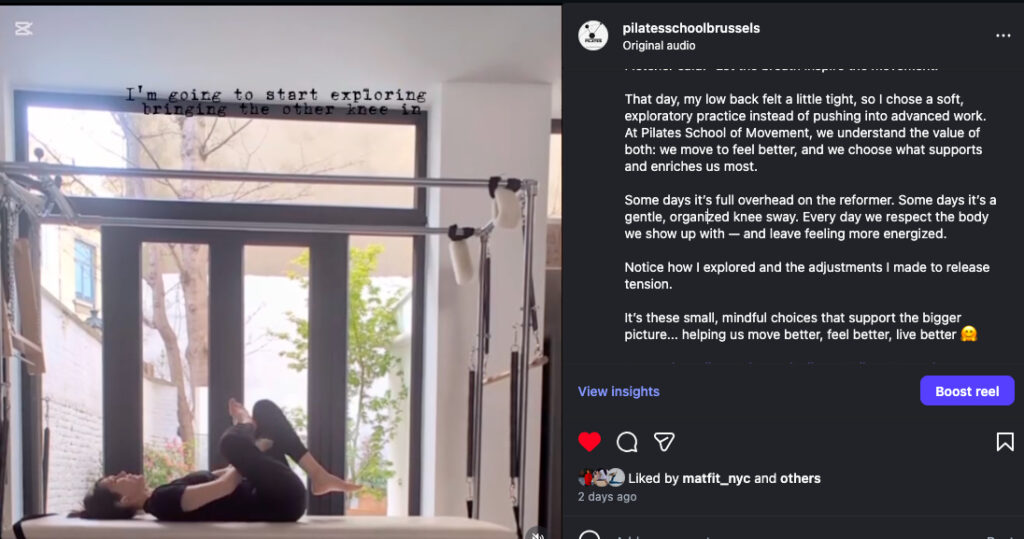
Last week, for example, my back felt a little tight, so I chose a slow, conscious Pre-Pilates exploratory movement session instead. Have a look at this post on Instagram to see how I explored and adapted.
At Pilates School of Movemente, we celebrate the body we show up with — and we move so we can feel better and more energized. That’s why our motto is Move Better. Feel better. Live better.
*To learn more about the work that Joseph Pilates and Eve Gentry carried together, have a look at this post: https://pilateschool.be/pilates-and-breast-cancer-awareness/
If you’re curious about starting Pre-Pilates or experiencing Classical Pilates for the first time, we’d love to welcome you to the studio. Come discover the method in a supportive, personalised environment. We are the only studio in Brussels dedicated to teaching Contrology Pilates in both private sessions and group classes. You’ll find us in Saint-Gilles at Chaussée de Charleroi 173, just a few minutes from Avenue Louise (Ixelles) and Place de la Trinité (Châtelain).