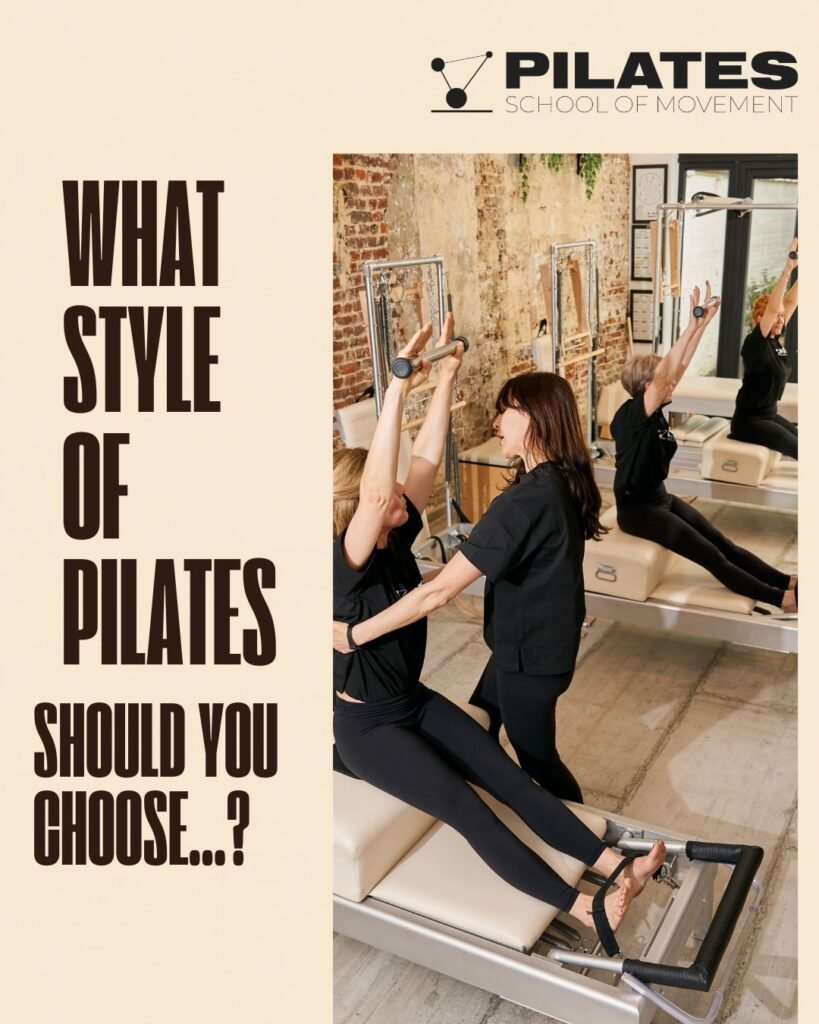
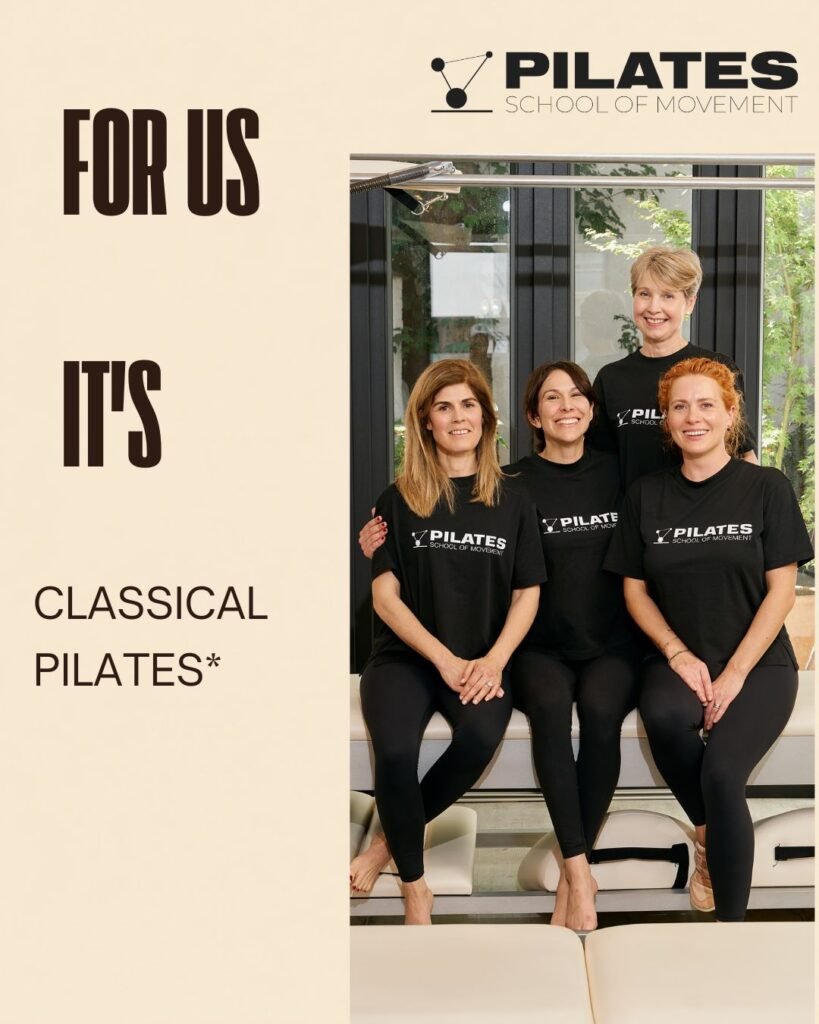
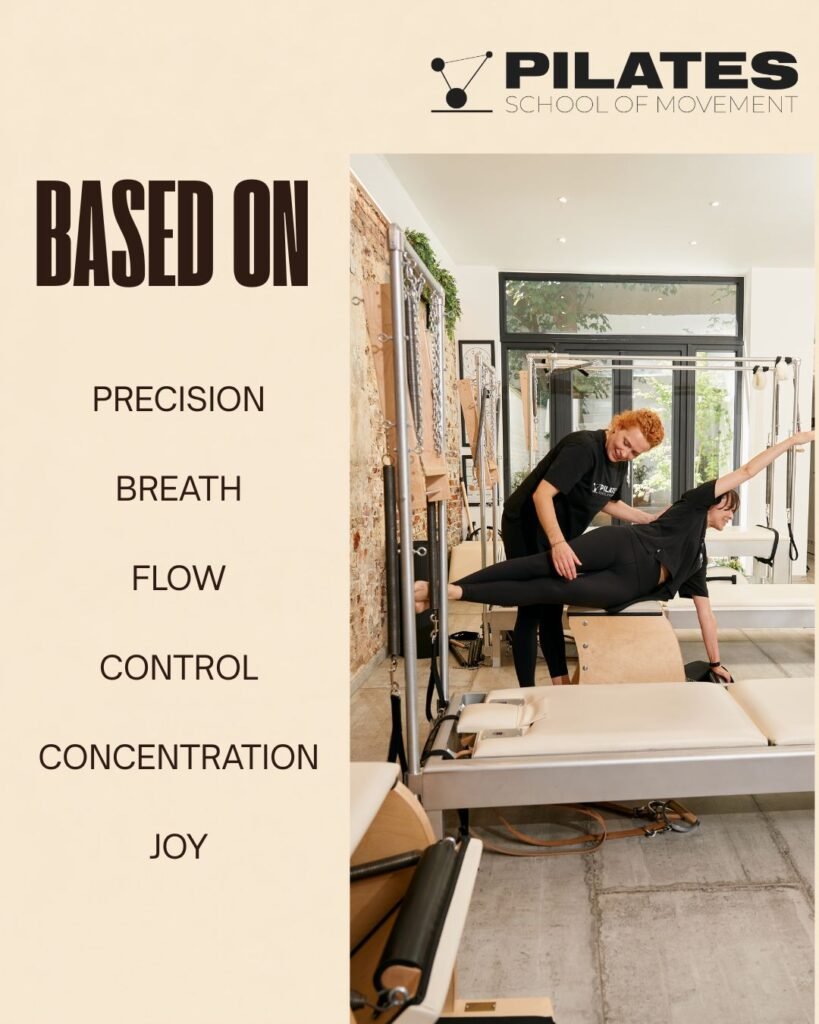
Pilates School of Movement is a Classical Pilates studio in Saint-Gilles, Brussels, working with small groups and private sessions on the original apparatus. Our approach emphasizes mindful movement, precise alignment, and progressive training for individuals at every level. We sometimes get asked how we came up in our Pilates training, or how someone could pursue training themselves. We don’t run a teacher training program ourselves — our focus is on working with people directly, the way Joseph Pilates did — but we wanted to put together a little summary of what to expect from Classical and Contemporary paths, so you have a starting point.
If you’d like to understand Classical Pilates specifically, the best way is to come try our style in the studio — from there, we’re happy to guide you toward the schools we know and trust. There are many training programs out there, and trying a style firsthand before committing makes a real difference in choosing well.
Whichever direction you’re drawn to, Classical or Contemporary, our advice remains the same: choose a programme that inspires you to become a great teacher, while allowing you to grow into the most fulfilled, inspired version of yourself.
Try classes in those studios with teachers trained under those programs, so you have a real sense of what your own work would look like.
Make sure your program prepares you for the reality of being a teacher, too. When we first step into the professional world, we can sometimes feel as though we’ve lost a little of what we were practicing. As students, we experience the method for ourselves, alongside a community of peers. As teachers, we step into a different role: creating that experience for others. The transition can be challenging, and a good training programme should prepare you for more than the technical aspects of teaching. It should also offer the guidance, confidence, and emotional support you need to find your feet as a professional. There will always be more to study, and continuing to learn is part of what makes this work so rewarding. But study should serve your practice as a teacher, helping you grow into your role rather than keeping you perpetually preparing for it. Ultimately, Pilates should remain something that enriches your life.
The right programme should challenge you and nurture you.
Why Contrology Exists
Joseph Pilates developed Contrology during World War I, out of necessity, in a hospital setting.
He was interned in England as a German national, first at Lancaster Castle and later at a camp on the Isle of Man. He began teaching his fellow internees exercise, and worked directly with patients unable to walk — rigging springs to hospital beds so bedridden men could move and strengthen their bodies. That improvised equipment became the direct ancestor of the Cadillac. The system was born as rehabilitation for people whose bodies had been broken by injury or illness.
So many of his most important students arrived at his studio seeking rehabilitation for a specific injury or condition. Romana Kryzanowska was sent to him by George Balanchine for a bad ankle. Kathy Grant was referred to him after knee surgery. Eve Gentry came to him after a radical mastectomy and later filmed her own sessions to demonstrate the results to doctors. Dancers and physicians sent people to Joseph Pilates because it worked when conventional treatment hadn’t.
In his own words, the method develops the body uniformly, corrects posture, restores vitality, invigorates the mind, and elevates the spirit — a complete coordination of body, mind, and spirit, aimed at making people better: stronger, clearer, more whole.
What “Classical” means
“Classical,” in any discipline, means conforming to an original, enduring standard — not a period style, but a fixed reference point that later work is measured against. In Pilates, that standard is Joseph and Clara Pilates’ own work, and Classical training means training that traces back, teacher to teacher, through their own direct students. That lineage works as a mechanism: it carries forward Joseph Pilates’ own philosophy and purpose for the work, alongside the movements themselves. That purpose was rooted in passion and a commitment to creating a better world — if a training program isn’t fully grounded in that same commitment, it may not be a direct reflection of what Joseph Pilates was actually trying to build.
It’s a common misconception that Pilates was designed specifically for dancers, or specifically for ballerinas. Dancers were certainly among his most devoted early students, and several — Romana Kryzanowska, Eve Gentry, Kathleen Stanford Grant, Ron Fletcher, among them — became the first generation of teachers who carried the method forward. But his ambition was broader than any one profession: correcting what modern life does to any human body, not building a program around dancers specifically.
Because Classical training passes directly from teacher to teacher, each instructor in that chain has also developed their own voice, their own way into the work, while staying anchored to the same source. That’s exactly why studying across more than one Classical lineage matters: it builds a fuller picture of Joseph Pilates’ actual intention, rather than one interpretation of it.
This also shows up in how each approach is built, knowledge-wise. In Classical training, Pilates comes first: the method itself is the foundation, and anything learned — anatomy, biomechanics — is layered on. In Contemporary training, the order is often reversed: a fitness or physiotherapy framework comes first, with Pilates exercises and equipment folded into that existing structure. Neither approach is illegitimate, but they produce a different relationship to the material — one where Pilates is the whole system being studied, and one where it’s a set of tools applied within another system.
Why the equipment matters
Classical schools train on apparatus built to Joseph Pilates’ original specifications — the same spring weights, carriage dimensions, and geometry he designed. Different equipment produces a different exercise: change the spring tension or the footbar geometry, and the exercise changes with it, even when the name stays the same. More archival material has come to light in recent years — original photographs, patents, and equipment specifications from Joseph Pilates’ own studio — showing apparatus he designed that remains largely unknown or unused today.
Contemporary schools generally design and manufacture their own equipment, and exercises are often adjusted to fit that equipment. The difference is more one of emphasis than of moves introduced — plenty of Classical teachers, ourselves included, borrow from other movement backgrounds to address specific needs.
Contemporary training and Classical training both prioritize precise execution of each movement. Classical training pairs that same precision with the mind-body-spirit intention Joseph Pilates considered central to the method.
The apparatus and the exercises were designed as one connected system — spring tension, sequencing, and exercise choice on each piece all inform one another.
What Classical training looks like
- Dedicated weekly hours on all the apparatus — Mat, Reformer, Cadillac, Chair, Barrels — as one connected system.
- Training under a small number of mentors over the course of the apprenticeship.
- Working live. Because the repertoire is so deeply internalized, a Classical teacher chooses and adapts exercises, responding to what’s actually happening with the client during the class.
- An ongoing personal responsibility to keep learning after certification. Instructors are expected to keep listening to different teachers and lineages within the Classical world throughout their career, building an understanding that reflects the full scope of Joseph Pilates’ work, life, and intention, informed by many voices.
- A mentor with real experience running a studio, not just teaching. A mentor who has actually built and run a studio can also guide you on the practical side (finding work, navigating the industry, etc.). Make sure whoever you train with is invested in your own professional path, and will respect and encourage you.
The clearest way to compare programs is to ask for the actual hours and structure directly, program by program. A Classical comprehensive typically requires 600+ hours minimum, including extensive supervised observation and practice teaching, completed over 18 to 24 months. Requirements vary a lot more among Contemporary programs, from around 10 hours plus a written exam up to more extensive tracks. That gap is worth understanding before you enroll anywhere, and it’s worth asking directly, for any program: how many practice, practice teaching and observation hours, who arranges them, and what does the exam actually involve.
One more thing worth knowing: in Classical Pilates, certification is consistently framed, by mentors and by the culture of the training itself, as the beginning of the learning process, not the end of it. That’s part of why the training itself runs so long — it’s building a habit of ongoing study that’s expected to continue for the rest of a teacher’s career.
Worth knowing too: instructors who go on to create their own training programs generally carry forward the tradition they came from — Classical if they trained solely in Classical, Contemporary if their training came from Contemporary schools. It’s worth asking any program directly which root their founders trained in.
How Contemporary schools describe themselves
There are many Contemporary programs out there. Each blends parts of Joseph Pilates’ original work with other disciplines — physiotherapy, movement science, dance, or fitness. As a result, they can also adjust their programming to fit current trends.
Having trained in both Classical and Contemporary, we can speak beautifully of each. What matters is understanding the real differences between them — purpose, history, origin, philosophy — so we know what we’re signing up for when we choose a training program.
Modular training: pros and cons
Many Contemporary programs let you build your certification module by module — Mat, then Reformer, then a specialty workshop, added over time rather than in one continuous block. That structure has real trade-offs worth weighing.
Short term, modular training is faster to start earning from, more flexible around a job or other commitments, and lower cost per step, since you’re not committing to 18–24 months upfront.
Long term, that same flexibility can mean gaps: modules from different providers don’t always connect into one coherent system, mentorship is often spread across multiple instructors rather than one continuous relationship, and it’s possible to be teaching clients before ever training on the full apparatus system. Paying separately for each module and specialty add-on can also end up costing more in total than a single comprehensive certification, even though each individual step looks cheaper upfront.
Questions to ask any studio or training program
If you’re interested in attending Classical Pilates classes in a studio or completing a Classical Pilates training, these are questions the studio and its trainers should be able to answer clearly:
- Is the work based on the philosophy of Joseph Pilates?
- Are the classes or the program closely based on the method Joseph Pilates created and studied, through his own records and the ones left or created by his students?
- What lineage do they follow? Names commonly quoted include Romana Kryzanowska, Eve Gentry, Kathy Grant, Ron Fletcher, and Jay Grimes.
- What equipment do they use? Gratz is the most celebrated Classical Pilates brand.
- How long was their training, and how was it structured? Classical Pilates teachers earn a full Comprehensive certificate rather than a series of modules, usually studying for 18 to 24 months, and they continue their education afterward.
Classical vs Contemporary Pilates training: the comparison
| Classical | Contemporary | |
|---|---|---|
| Certification hours | 600+ hours minimum, 18-24 months | Ranges from around 10 hours plus one exam, up to more extensive tracks |
| Training structure | Apprenticeship under a small number of mentors, cross-training across lineages encouraged | Modular; multiple faculty across separate courses |
| Apparatus | Built to Joseph Pilates’ original specifications | Modified equipment, designed by each school |
| Approach to the body | The body is worked as a whole, and the apparatus are parts of one system that develops movement skills. The teacher will know and embody the repertoire profoundly, so adjustments are made for the specific person. | Apparatus are usually studied as separate pieces, each used to work specific body areas. Classes are encouraged to be prepared ahead |
| Principles of Pilates | Principles interpreted from Joseph Pilates’ own records (including physical, mental and spiritual health) | Focused on biomechanics |
| Focus | Precise movement execution, paired with mind-body-spirit intention | Precise movement execution |
| Required reading | Joseph Pilates’ own books, studied directly, plus a full bibliography on anatomy, biomechanics, imagery, etc. | Varies by program |
| Knowledge of Pilates history | Essential, and part of the training from the start | Usually not required for certification |
| Archival study | Commonly included | Not typically part of the curriculum |
| After certification | Explicitly framed as the beginning of a lifelong learning process | Modular; specializations added over time |
| Name of the method | Contrology, alongside Pilates | Pilates |
Why Pilates School of Movement is Classical
Pilates found us the way it finds a lot of people: through pain. Years of migraines led to a first class, and what followed was a body that felt stronger, more flexible, and more connected than before — and a life that had more room in it because of that.
We’re not here to judge any training path — every program has something to offer, and we learned a great deal from our Contemporary training along the way. We ultimately chose to teach Classical because, in our own bodies and with our clients, it’s the most effective system we’ve tried: the mentors who trained us directly in that lineage gave us a full picture of the work. That’s what we teach from, every class, and it’s why our studio is built the way it is.
At Pilates School of Movement, this means private sessions and guided small group classes (defined as everyone in the room doing the same exercise at the same time, led in real time by a teacher watching and adjusting for each person).
Whichever path you choose, we hope you find your career as inspiring and fulfilling as ours has been. We teach because we want people to move, feel, and live better — in their bodies, their minds, and their spirits 💛